“Cockroach Janta Party” Emerges as a Symbol of Youth Frustration in India
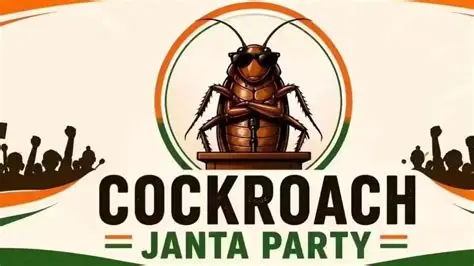
A satirical online political movement called the “Cockroach Janta Party (CJP)” has rapidly gained attention across India, becoming a powerful expression of frustration among young people over unemployment, economic hardship and political dissatisfaction.
The movement was launched by 30-year-old Abhijeet Dipke, a recent public relations graduate from Boston University in the United States. What began as a casual joke on social media has now transformed into a viral political satire movement attracting thousands of supporters online every day.
The controversy began after Chief Justice of India Surya Kant made remarks during an open court hearing, where he compared some unemployed young people to “cockroaches.” He stated that certain unemployed individuals become media persons, social media activists or RTI activists and begin attacking institutions and society.
Although Justice Surya Kant later clarified that his comments were aimed at individuals obtaining fraudulent degrees and not at Indian youth in general, the remarks sparked widespread anger, particularly among Gen Z users already struggling with unemployment, inflation and social divisions.
In response, Abhijeet Dipke posted on X (formerly Twitter), asking, “What if all cockroaches come together?” The post quickly gained traction, leading him to create the “Cockroach Janta Party,” a satirical play on the ruling Bharatiya Janata Party (BJP). The word “Janta” means “people” in Hindi.
Speaking to media outlets, Dipke said, “Those in power think citizens are cockroaches and parasites. They should know that cockroaches breed in rotten places. That’s what India has become today.”
Within just three days, the party’s Instagram account reportedly crossed more than 11 million followers, while over 350,000 people signed up for membership through an online form. The rapid growth of the movement surprised many political observers and social media analysts.
Several political personalities and public figures have also shown interest in the movement. Opposition parliamentarian Mahua Moitra and former MP Kirti Azad were among those reported to have signed up or expressed support.
The rise of the movement reflects growing frustration among India’s youth. Despite India producing millions of graduates every year, unemployment among graduates remains extremely high. Economic inequality, rising living costs and concerns about democratic freedoms have intensified dissatisfaction among younger generations.
The “Cockroach Janta Party” has positioned itself as both a humorous protest and a commentary on modern Indian politics. Its satirical membership criteria include being unemployed, lazy, chronically online and capable of “ranting professionally.”
The party’s slogan describes it as:
“A political front of the youth, by the youth, for the youth – Secular, Socialist, Democratic and Lazy.”
Its online manifesto humorously criticizes issues such as voter manipulation allegations, political influence over institutions, media bias and the close relationship between powerful business figures and politics.
Dipke stated that he used artificial intelligence tools such as ChatGPT and Claude to build the party’s branding, manifesto and online presence within 24 hours. The movement has since evolved into a larger internet phenomenon, especially among frustrated young Indians seeking alternative political expression.
Political commentators believe the popularity of the Cockroach Janta Party reflects deeper dissatisfaction with traditional political structures rather than support for an actual political party. Many see it as a symbol of youth anger, sarcasm and demand for accountability.
Observers have also linked the movement to a broader trend of youth-led protests and online activism seen across South Asia in recent years, including movements in Sri Lanka, Bangladesh and Nepal.
While the Cockroach Janta Party began as a joke, many now believe it has become a serious social commentary on the frustrations, anxieties and political disillusionment of India’s younger generation.