Mullivaikkal Commemoration Held with Emotion; “Mullivaikkal Declaration – 2026” Read
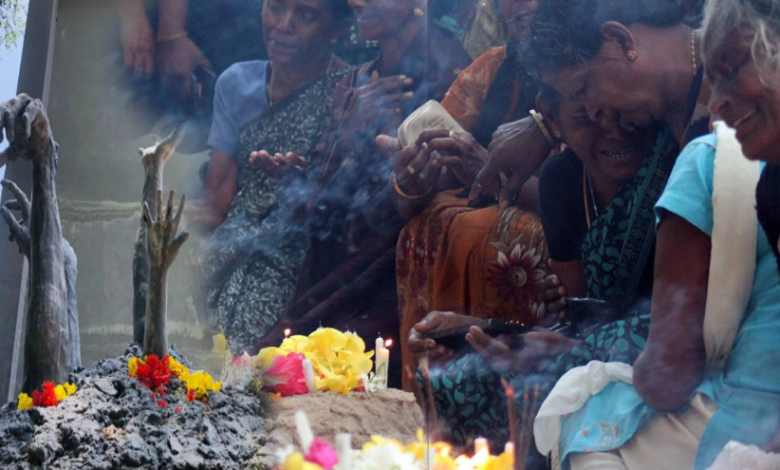
The 17th anniversary remembrance of the Mullivaikkal Tamil genocide was held today (18) with deep emotion at the Mullivaikkal Memorial site.
The commemorative event honoring those who were killed during the war took place at the memorial erected in Mullivaikkal.
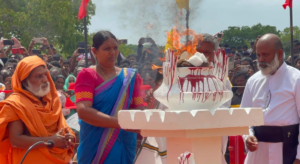
The event commenced at 10.15 a.m. with the reading of a policy declaration by Thavathiru Agathiyar Adigal. At 10.29 a.m., a remembrance signal was sounded, followed by a moment of silence at 10.30 a.m. Subsequently, a common flame was lit by Sriranjan Rinosha of Vattappalai—who lost four family members in the final war period—followed by simultaneous lighting of individual lamps, and floral tributes were offered.
A woman from Vattappalai, Mullaitivu, who lost relatives during the final phase of the war, lit the main memorial flame, while others lit lamps at the same time.
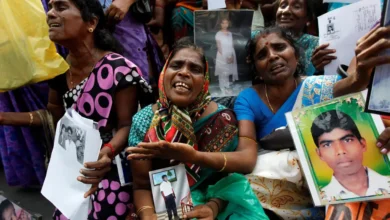
Following this, floral tributes were paid at the Mullivaikkal memorial monument. During the event, relatives of the deceased broke down in tears while offering their respects.
Parliamentarians including D. R. Ravikaran, Gajendrakumar Ponnambalam, S. Sritharan, former MP Selvarasa Gajendran, other political representatives, religious leaders, and a large number of civilians participated in the remembrance event.
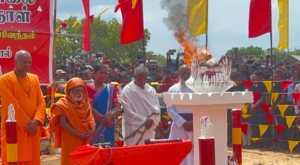
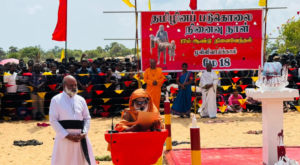
“Mullivaikkal Declaration – 2026” Read at the Memorial
In the commemorative event, the “Mullivaikkal Declaration – 2026” was read out as follows:
Dear Eelam Tamil people,
Seventeen years have passed since the peak of the Tamil genocide at Mullivaikkal. The process of Tamil genocide has a historical evolution spanning more than a century. It is rooted in geopolitical interests of imperial structures and the preservation of Sinhala-Buddhist majoritarian dominance. The memory of Mullivaikkal continues to challenge the false narrative that the armed phase of Tamil political aspiration was brought to an end there.
Even after 17 years, we gather at this ground without proper memorials for thousands of our slain relatives, with only the sky as witness and the wind carrying their dreams. Our collective political demands are just and grounded in justice.
Global geopolitical rivalries between unipolar and multipolar world orders continue under imperial frameworks. Whether the world shifts toward multipolarity or not, domination structures remain. Therefore, our strategies for liberation must also evolve accordingly.
Tamil people’s land continues to be militarized, occupied, and subjected to systematic structural oppression. Cultural identity, religious sites, and historical heritage are being destroyed or distorted. Attempts are made to rewrite history and erase Tamil national identity.
Drug proliferation is also described as a deliberate political strategy used against the younger generation, targeting the future of the Tamil nation.
Accountability mechanisms have been distorted and used politically. Justice demands for the genocide, land rights struggles, and issues of enforced disappearances continue to be suppressed.
The combined pressure of the Sinhala-Buddhist state structure and global power systems has created an ongoing war against the Tamil nation—affecting land, identity, and collective consciousness.
The declaration further stated that Tamil national identity and collective memory remain the strongest form of resistance. As long as remembrance continues, erasure is impossible.
It emphasized:
- Protection of Tamil homeland from Sinhala-Buddhist assimilation
- International accountability and prosecution of crimes
- Recognition of Tamils as a nation with self-determination rights
- Prevention of structural genocide against the Tamil people
- Continued unified struggle for liberation under a common political vision
The declaration concluded by reaffirming continued resistance and collective struggle for Tamil national rights and self-determination.